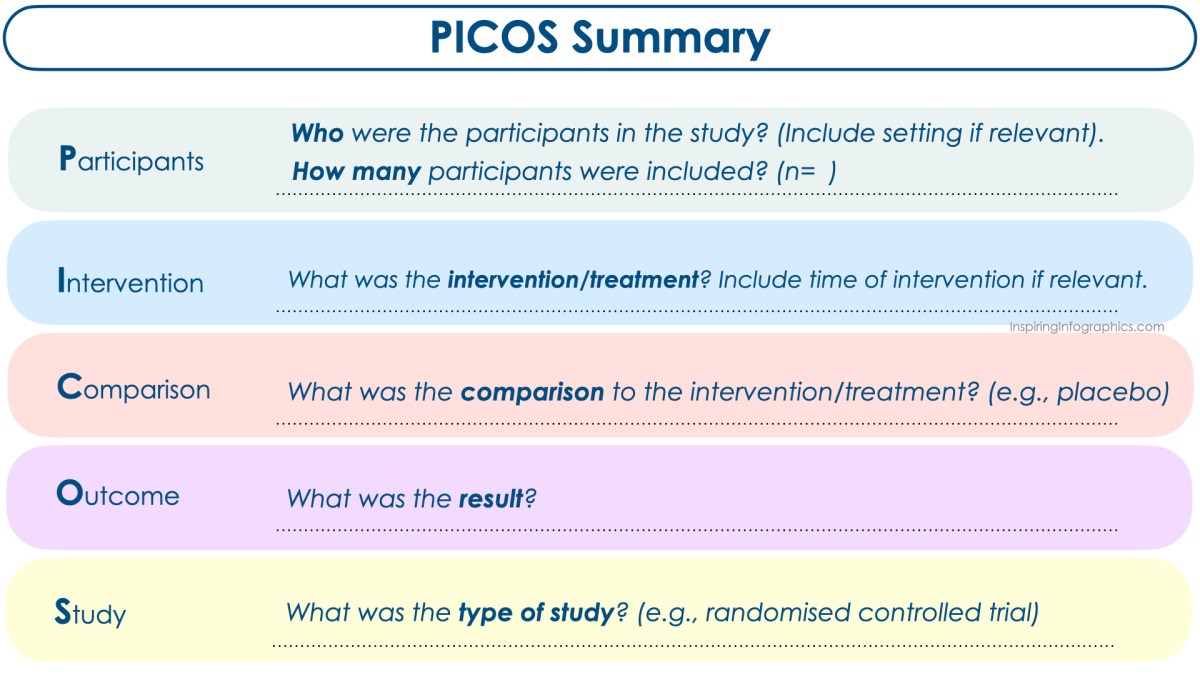
PICOS and SPIDER summaries: are very useful for searching studies in scientific literature databases, creating protocols for research, and helping us to study. The PICOS summary is used for quantitative research and stands for:
P – Participants: specify the participants and its characteristics and their context if it is relevant. Enter the total number of participants.I – Intervention: state the intervention or treatment and include how long the intervention took, if relevant.
C – Comparison: what did the intervention or treatment was compared with? Add the comparison treatment, for instance placebo.
O – Outcome: is the result of the study.S – Study: specify the type of study, for example whether it was a randomised controlled trial, a longitudinal study, etc.T
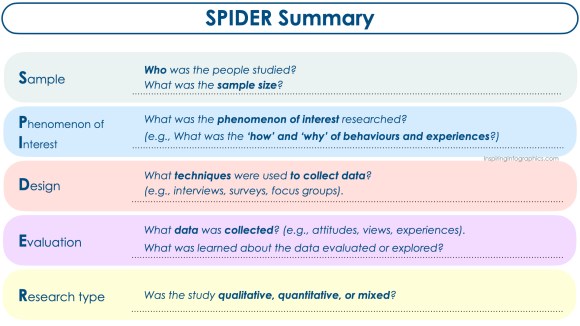
he SPIDER summary: can be more helpful for qualitative research, and stands for:
S – Sample: who were the people studied? Add the sample size.
PI – Phenomenon of Interest: this is the phenomenon of interest researched such as the ‘how’ or ‘why’ of behaviour and experiences.
D – Design: that is, the techniques employed to get data, like interviews.
E – Evaluation: this is what was learned from the evaluation or exploration of the data. Specify first the data collected, for instance: attitudes, views, experiences.
R – Research type: state whether the study was qualitative, quantitative or mixed.
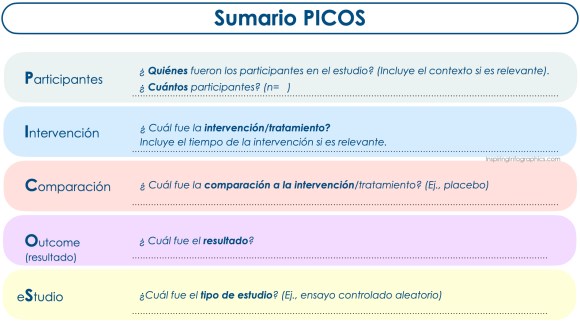
Sumarios PICOS y SPIDER: son muy útiles para buscar estudios en bases de datos de literatura científica, crear protocolos de investigación y ayudarnos a estudiar. El sumario PICOS se utiliza para la investigación cuantitativa y significa:
P – Participantes: especifica los participantes y sus características y su contexto si es relevante. Introduce el número total de participantes.
I – Intervención: indica la intervención o el tratamiento, e incluye cuánto tiempo duró la intervención, si corresponde.
C – Comparación: ¿Con qué se comparó la intervención o el tratamiento? Agrega el tratamiento de comparación, por ejemplo, si se utilizó placebo.
O – (Outcome) – resultado: se trata del resultado del estudio.
S – (Study) – studio: especifica el tipo de studio, por ejemplo, si fue un ensayo controlado aleatorio.
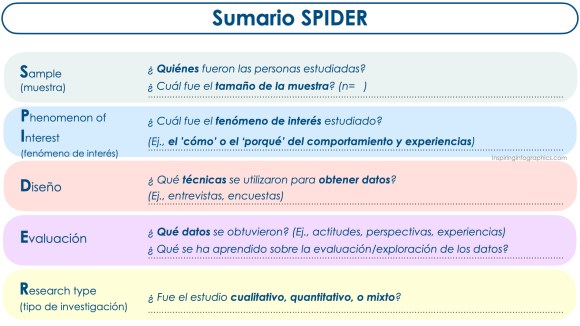
El sumario SPIDER se usa para los estudios qualitativos.
S – (Sample) – muestra: especifica quiénes fueron las personas estudiadas, y el tamaño de la muestra.
PI – (Phenomenon of Interest): el fenómeno de interés estudiado, por ejemplo: el ‘porqué’ or el ‘cómo del comportamiento y experiencas D – Diseño – incluye las técnicas que se utilizaron para obtener datos, ej., entrevistas.
E – Evaluación – una vez que se escriben los datos recogidos (ej., actitudes, perspectivas, experiencias) se reflexiona sobre lo que se ha aprendido sobre la evaluación o exploración de los datos del estudio.
R – (Research type) / especifica el tipo de investigación (ej., qualitativo, quantitativo, o mixto).
 InspiringInfographics