Categorías
communication comunicación investigación research

Scientific Poster / Póster Científico

Do you need to design a poster for a conference and don’t know where to start?

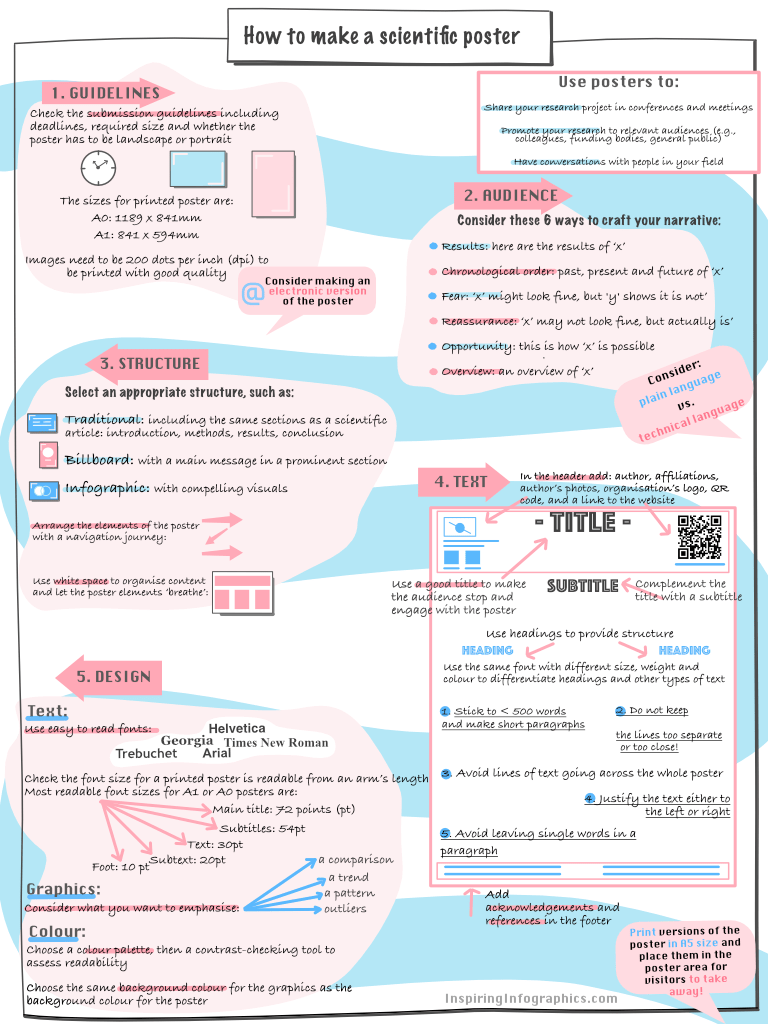
Posters are a great way to share your research project in conferences and meetings, to promote your research to different audiences and to start conversations with people in your field.
Follow these five steps to make your poster:

First have a look at the submission guidelines: when is it due by, the sizes, and all the requirements. Even if you are going to print a poster, it may be useful to have an electronic version to share it via email or social media.

Second, think about the audience, and how can you best craft your narrative.

Third: select an appropriate structure, you can go for the traditional one, using the same sections as a scientific study; or go for a more modern approach, including just a main message and a QR link to the main study.

Fourth: use the header to include information about the authors and the department, and the foot to add acknowledgments and references. Do not write more than 500 words for the whole poster.

Finally, improve your poster by making sure the text is easy to read, consider which graphics to add depending on what you need to emphasise. Select a colour palette and make sure the text is still readable.
¿Necesitas diseñar un póster para una conferencia y no sabes por dónde empezar?

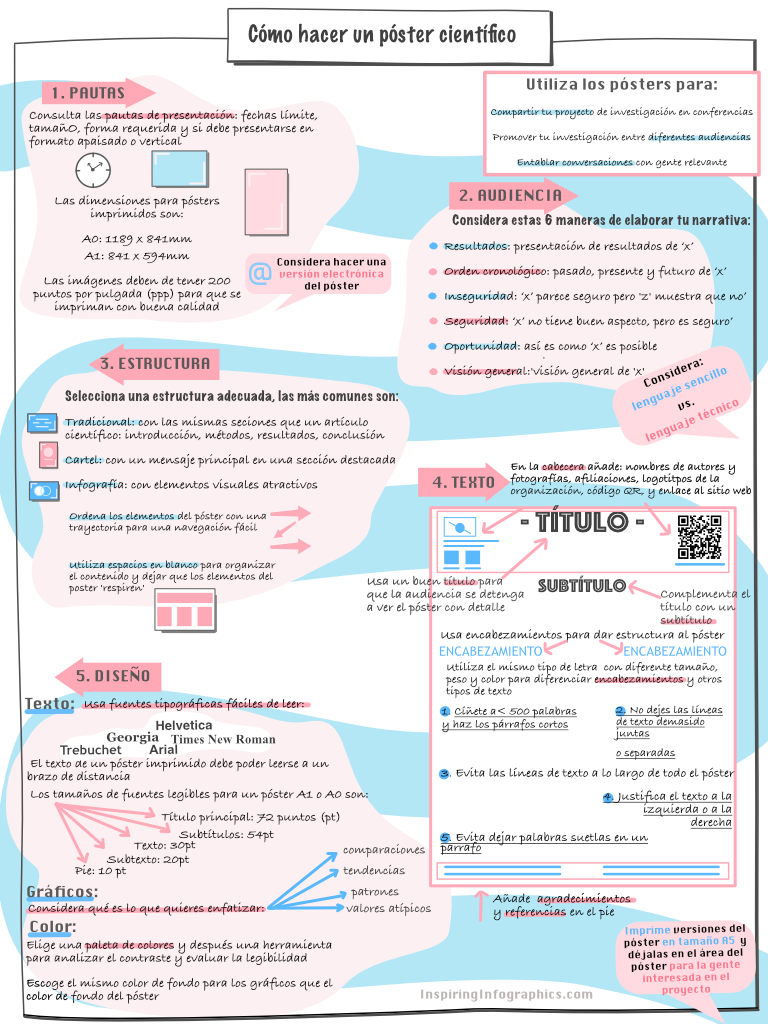
Los pósters son una excelente manera de compartir tu proyecto de investigación en conferencias y reuniones, promover tu investigación a diferentes audiencias e iniciar conversaciones con personas relevantes en tu campo.

Sigue estos cinco pasos para hacer tu póster:

Primero, echa un vistazo a las pautas de envío: cuándo se debe entregar, los tamaños y todos los requisitos. Incluso si vas a imprimir un póster, puede ser útil tener una versión electrónica para compartir por correo electrónico o redes sociales.

Segundo, piensa en la audiencia y en cómo puedes elaborar mejor tu narrativa.

Tercero: selecciona una estructura adecuada, puedes optar por la tradicional, utilizando las mismas secciones que un estudio científico u optar por un enfoque más moderno, incluyendo un mensaje principal y un enlace QR al estudio principal.

Cuarto: utiliza la cabecera para incluir información sobre los autores y el departamento, y el pie para añadir agradecimientos y referencias. No escribas más de 500 palabras para todo el póster.

Por último, mejora tu póster asegurándote de que el texto sea fácil de leer. Piensa qué gráficos añadir según lo que necesites destacar. Selecciona una paleta de colores y asegúrate de que el texto se puede leer.
Categorías
investigación research

PICOS-SPIDER summaries / Sumarios PICOS-SPIDER

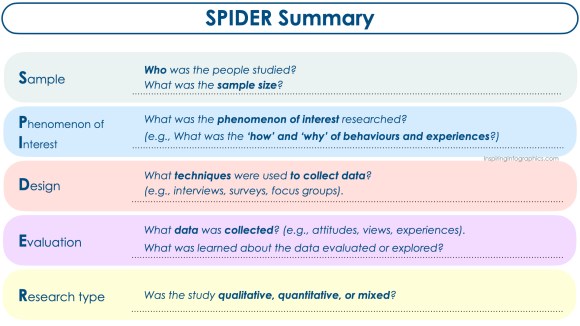
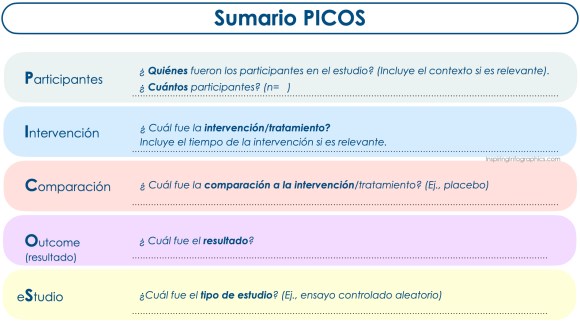
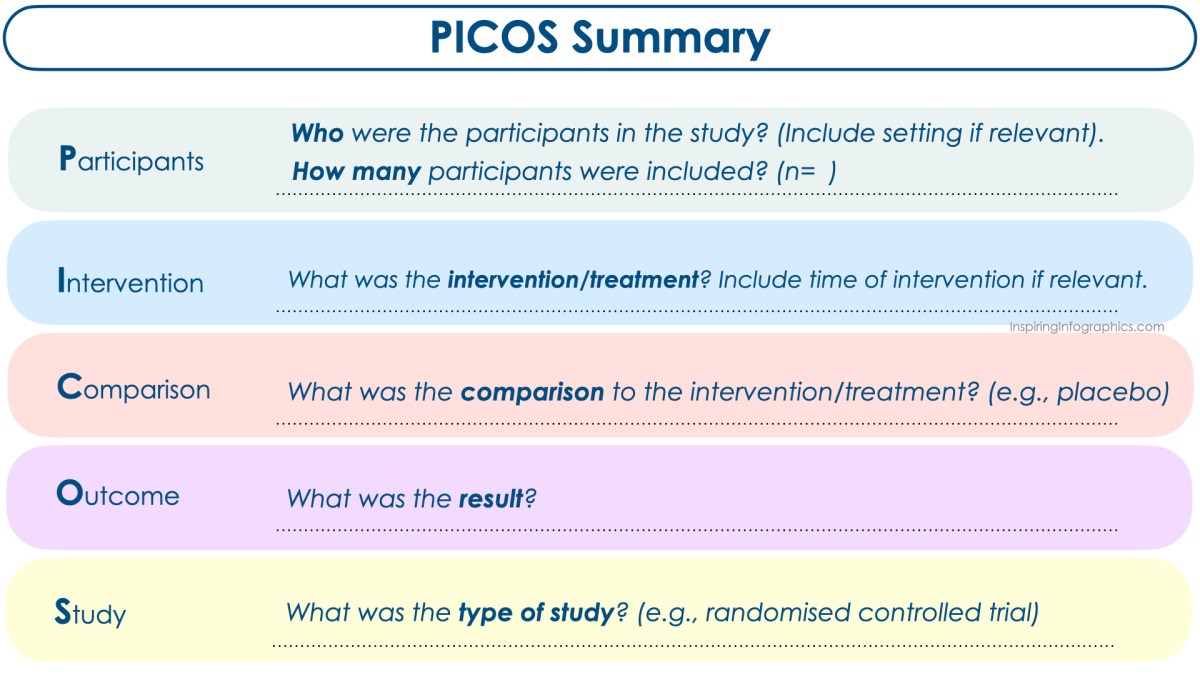
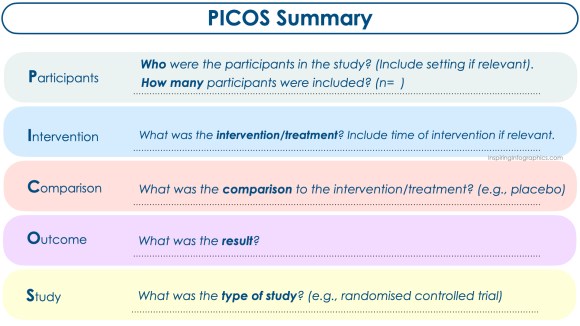
PICOS and SPIDER summaries: are very useful for searching studies in scientific literature databases, creating protocols for research, and helping us to study. The PICOS summary is used for quantitative research and stands for:

P – Participants: specify the participants and its characteristics and their context if it is relevant. Enter the total number of participants.I – Intervention: state the intervention or treatment and include how long the intervention took, if relevant.

C – Comparison: what did the intervention or treatment was compared with? Add the comparison treatment, for instance placebo.

O – Outcome: is the result of the study.S – Study: specify the type of study, for example whether it was a randomised controlled trial, a longitudinal study, etc.T

he SPIDER summary: can be more helpful for qualitative research, and stands for:

S – Sample: who were the people studied? Add the sample size.

PI – Phenomenon of Interest: this is the phenomenon of interest researched such as the ‘how’ or ‘why’ of behaviour and experiences.

D – Design: that is, the techniques employed to get data, like interviews.

E – Evaluation: this is what was learned from the evaluation or exploration of the data. Specify first the data collected, for instance: attitudes, views, experiences.

R – Research type: state whether the study was qualitative, quantitative or mixed.

Sumarios PICOS y SPIDER: son muy útiles para buscar estudios en bases de datos de literatura científica, crear protocolos de investigación y ayudarnos a estudiar. El sumario PICOS se utiliza para la investigación cuantitativa y significa:
P – Participantes: especifica los participantes y sus características y su contexto si es relevante. Introduce el número total de participantes.
I – Intervención: indica la intervención o el tratamiento, e incluye cuánto tiempo duró la intervención, si corresponde.
C – Comparación: ¿Con qué se comparó la intervención o el tratamiento? Agrega el tratamiento de comparación, por ejemplo, si se utilizó placebo.
O – (Outcome) – resultado: se trata del resultado del estudio.
S – (Study) – studio: especifica el tipo de studio, por ejemplo, si fue un ensayo controlado aleatorio.

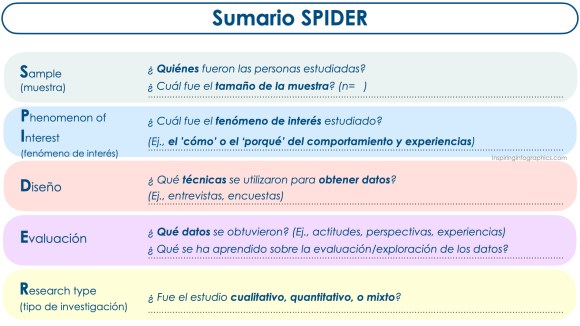
El sumario SPIDER se usa para los estudios qualitativos.
S – (Sample) – muestra: especifica quiénes fueron las personas estudiadas, y el tamaño de la muestra.
PI – (Phenomenon of Interest): el fenómeno de interés estudiado, por ejemplo: el ‘porqué’ or el ‘cómo del comportamiento y experiencas                                                                                           D – Diseño – incluye las técnicas que se utilizaron para obtener datos, ej., entrevistas.
E – Evaluación – una vez que se escriben los datos recogidos (ej., actitudes, perspectivas, experiencias) se reflexiona sobre lo que se ha aprendido sobre la evaluación o exploración de los datos del estudio.
R – (Research type) / especifica el tipo de investigación (ej., qualitativo, quantitativo, o mixto).       

Categorías
communication comunicación investigación research

Science Communication / Comunicación Científica

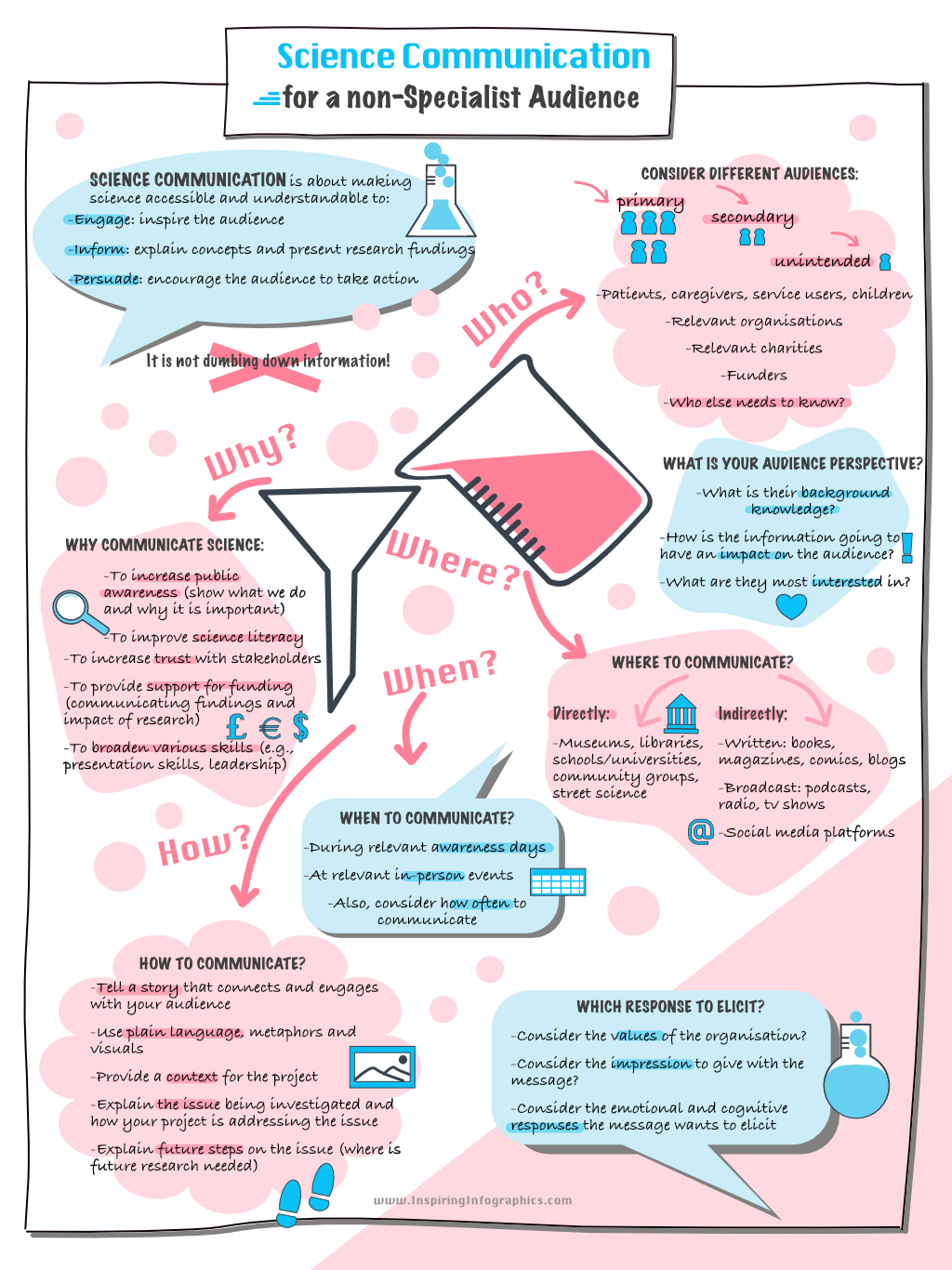
Science communication is about making science accessible and understandable to engage and inspire the audience, to explain concepts and present research findings and also to encourage people to take action.
To communicate to a non-specialist audience, consider who is your primary audience, and also think about the secondary and unintended audiences.
There could be different reasons to communicate science, for instance: to increase public awareness on a topic, to improve trust with stakeholders, or to explain funders why is necessary to conduct a piece of research. Also, for yourself as a scientist, science communication provides you with opportunities to broaden your skills.
Consider your audience perspective: what do they know already about the topic and how much? What areas do you think they would like to find out more about?
Telling a story using plain language, metaphors and visuals will definitely spark interest and curiosity from the audience.
There are many different ways to communicate science, which could be directly, like for instance talking to the people in person in museums, or indirectly, for instance designing comics.
See which awareness days could be relevant for your topic and if you missed one of the relevant days this year, then use the time to plan in advance for next one.

La comunicación científica consiste en hacer que la ciencia sea accesible y comprensible para involucrar e inspirar a la audiencia, explicar conceptos y presentar los resultados de las investigaciones y también alentar a las personas a actuar.
Para comunicar a una audiencia no especializada, considera tu audiencia principal y también piensa en la audiencia secundaria e imprevista.
Puede haber diferentes razones para comunicar la ciencia, por ejemplo: aumentar la conciencia pública sobre un tema, mejorar la confianza con las partes interesadas o explicar a los financiadores por qué es necesario realizar una investigación. Además, como científico, este tipo de comunicación te brinda oportunidades para ampliar habilidades.
Considera la perspectiva de tu audiencia: ¿qué saben ya sobre el tema y cuánto? ¿Sobre qué áreas crees que les gustaría saber más?
Contar una historia utilizando un lenguaje sencillo, metáforas y elementos visuales definitivamente despertará interés y curiosidad.
Hay muchas formas diferentes de comunicar la ciencia, directamente por ejemplo hablando en persona en museos, o indirectamente por ejemplo, diseñando cómics. Mira qué días de concienciación podrían ser relevantes para tu tema y, si perdiste uno de los días relevantes este año, entonces usa el tiempo para planificar con anticipación para el año que viene.