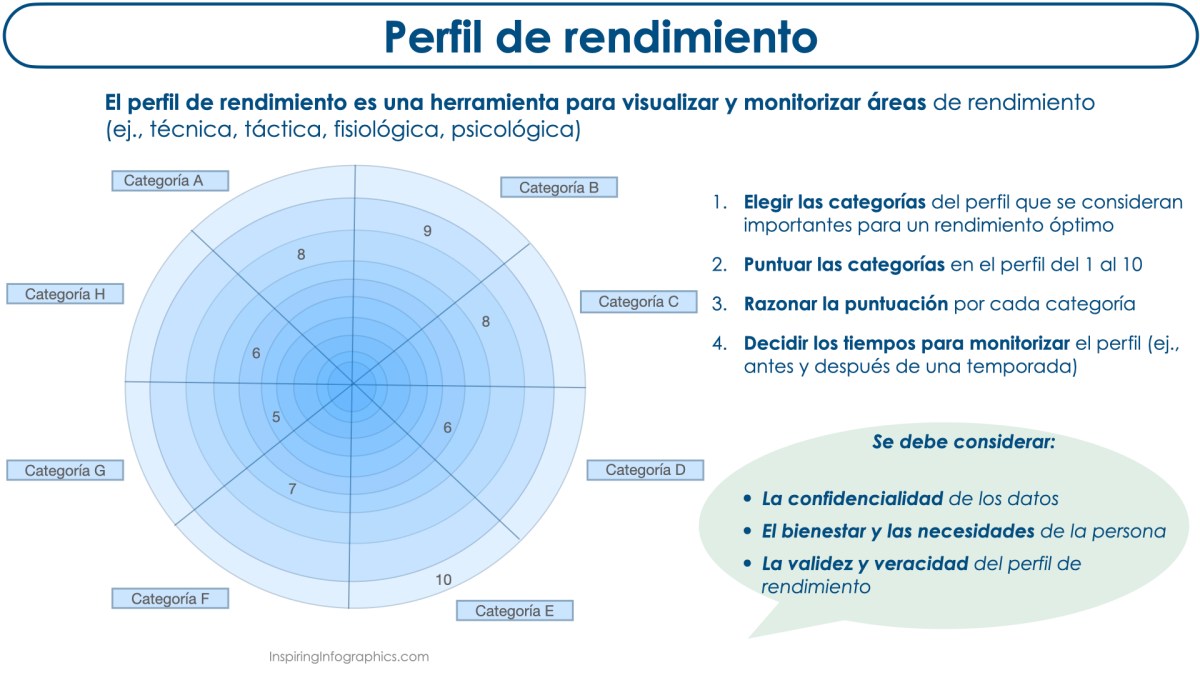
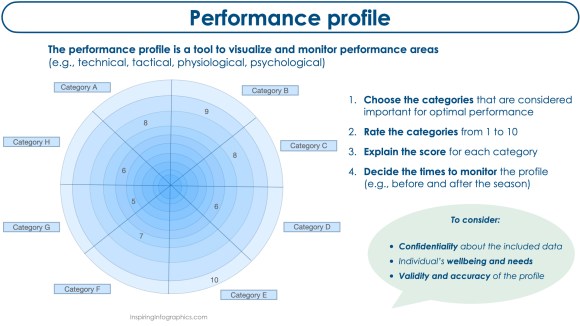
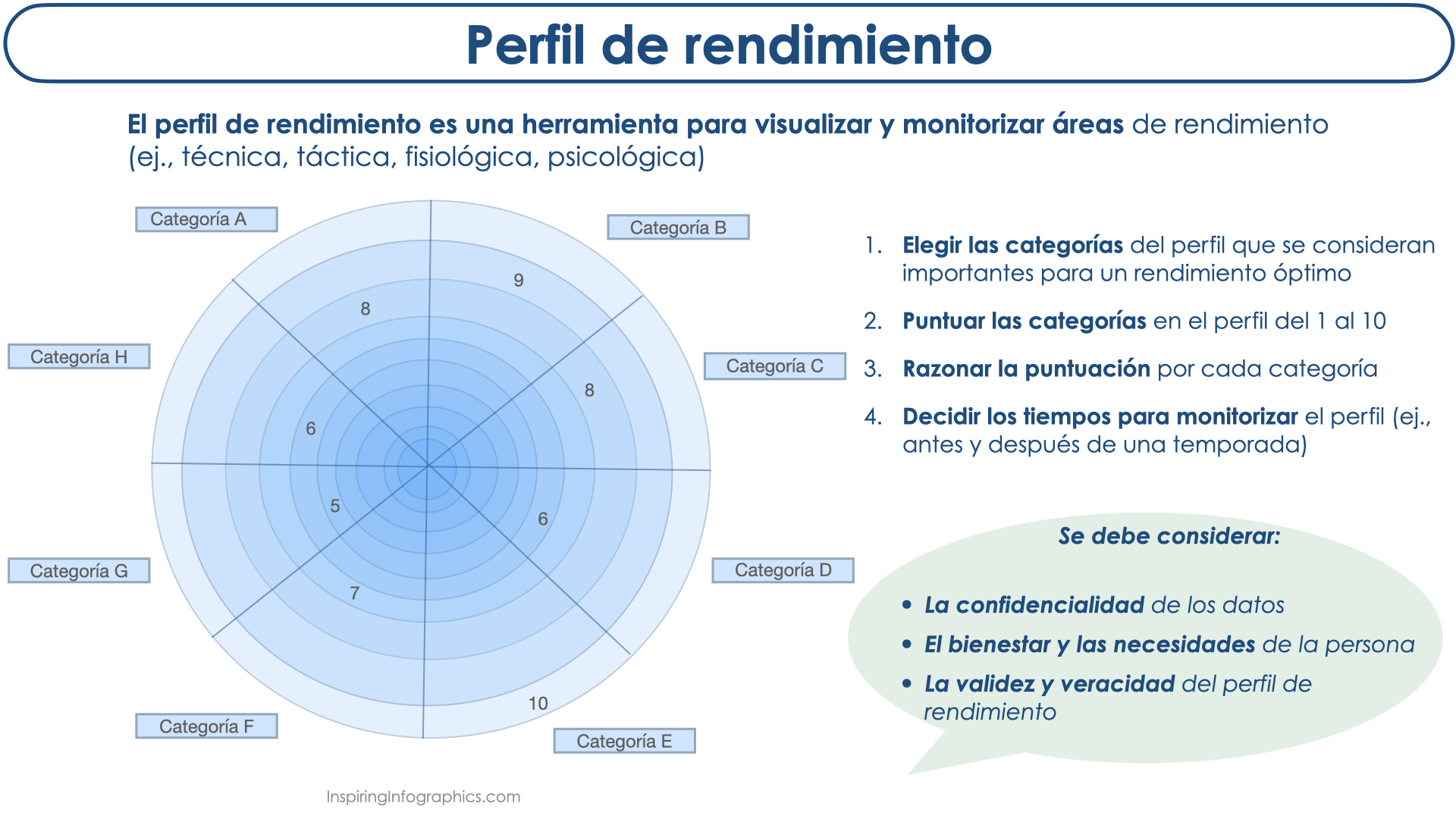
The performance profile was created by Butler and Hardy in 1992. It is a method to visualize and monitor certain areas of performance; and it is useful for goal setting, motivation, and self-awareness. It can be completed in several ways. Firstly, the categories to be included and the times when the values are going to be noted down (for instance, before and after the season) are selected. Then those categories get rated on a scale from 1 to 10. The first profile completed (e.g., before the season) could be compared to a second one (e.g., after the season) to see progress over time. When creating the profile, the following should be considered: confidentiality about the data included, the wellbeing and needs of the athlete, and the validity and veracity of the profile.
El perfil de rendimiento fue creado por Butler y Hardy en 1992. Es un método para visualizar y monitorear áreas destacadas del rendimiento; es útil cuando se establecen objetivos, para la motivación y el autoconocimiento. Aunque se puede hacer de varias maneras básicamente primero se escogen las categorías que se van a incluir y los tiempos en las que se van a apuntar los valores (por ej., antes y después de la temporada). Después se valoran las cualidades incluidas por ejemplo en una escala del 1 al 10. El primer gráfico hecho por ejemplo antes de la temporada se podría comparar con otro después de la temporada para ver el progreso. Al crear el perfil se debe considerar lo siguiente: confidencialidad sobre los datos incluidos, el bienestar y necesidades del atleta, y la validez y veracidad del perfil.
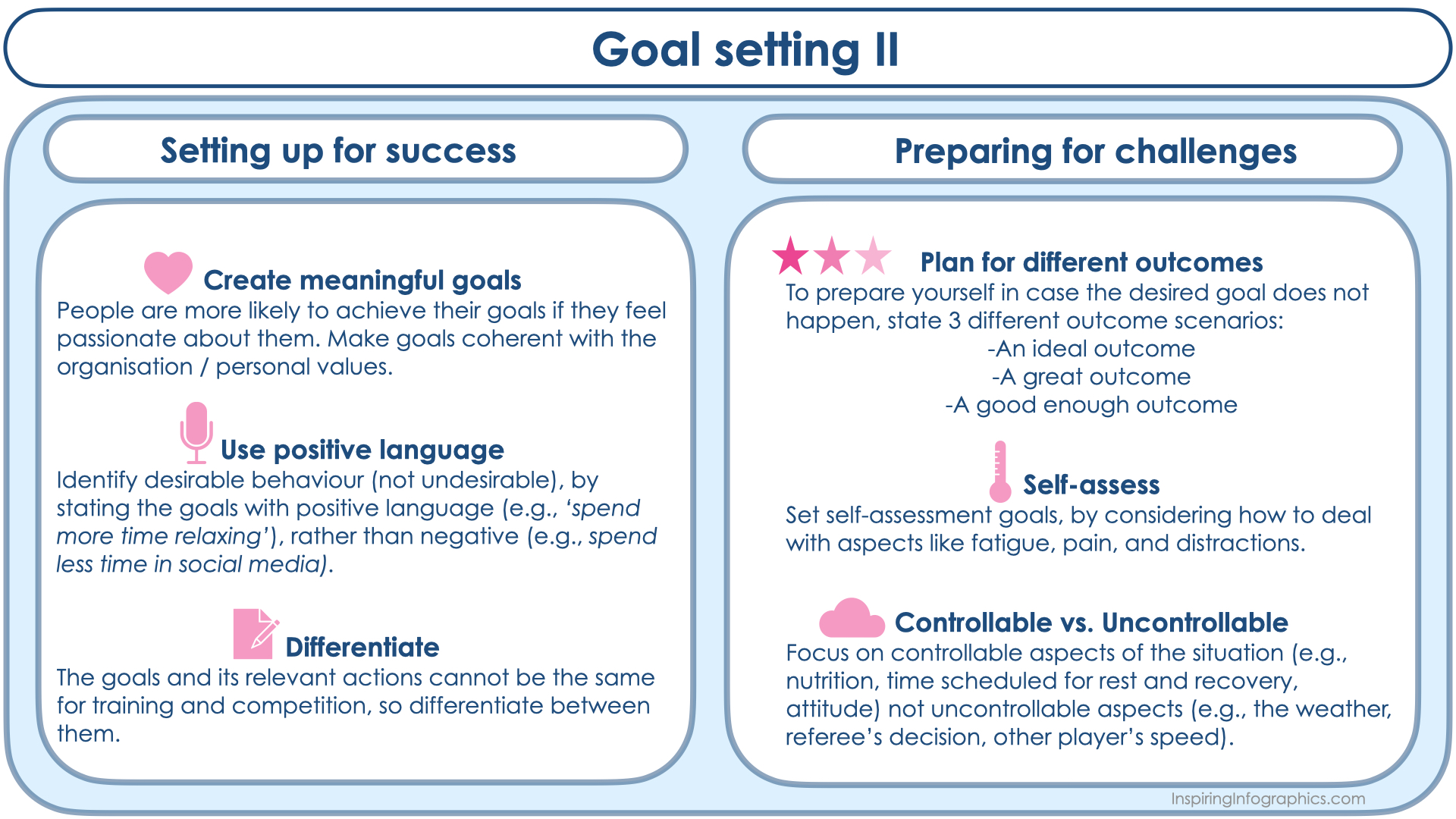
Before starting to train it is essential to set a goal to motivate ourselves, and stimulate our learning journey. To set up a goal like completing a 10kms run, we have to identify what we want to achieve (e.g., completing the race on a particular time, or simply just completing it), bearing in mind the time and resources available, and our physical condition.
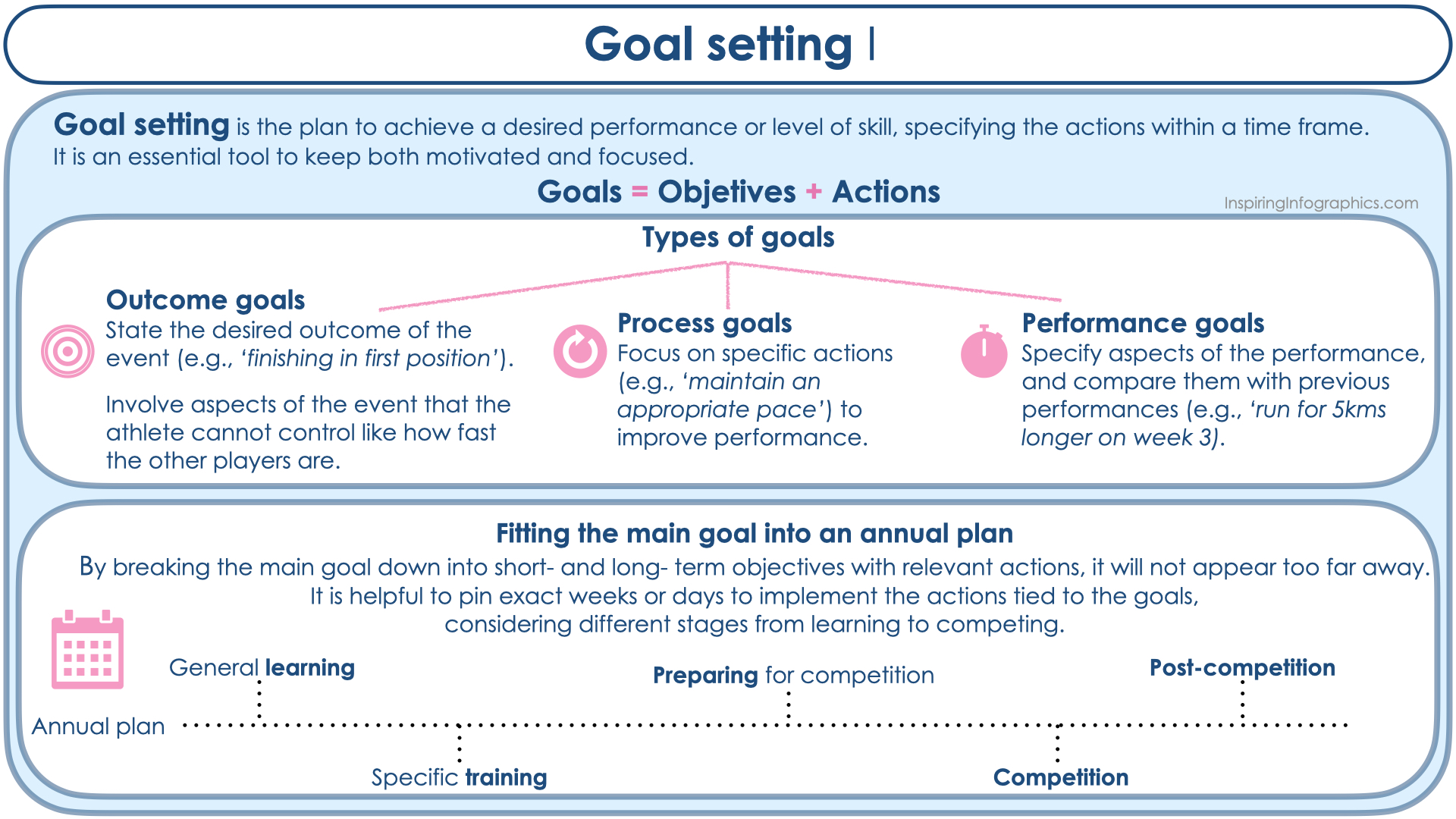
When the goals are simply statements on what we would like to achieve, then we can get disappointed if we have not identified beforehand the steps that are going to lead us to it. Another source of disappointment is when we include aspects that are beyond our control, like for instance the speed of the other runners. For these types of goals (e.g., finishing first on a competition), part of the effort is wasted by comparing ourselves to others.
Once we have decided on a goal, we need to identify at least three objectives on a short term, being as specific as possible and including a time limit to achieve them (e.g., doing core, quads and biceps exercises three times a week, and doing yoga on the rest days). We also have to identify the actions we need to do to achieve the objectives (e.g., going to the gym, consulting a personal trainer on stretching and warming exercises on the first week).
A continuous evaluation of our performance objectives is another important aspect to succeed. Some athletes find useful writing the objectives on a diary alongside the exercises completed to check whether they are meeting the objectives or they need to be modified. In this diary, they can also reflect on the obstacles they encounter and ideas to overcome them.
It is also worth remembering that the goal is the level of performance we want to achieve and the success depends on whether we achieve the actions related to the objectives.
Goal = desired level of skill or performance
Goal = objectives + actions
Goal setting helps us to: motivate, have a focused effort and learn.
The goal should be realistic, containing objectives and actions linked to them.
The objectives and actions have to be specific and have a deadline.
It is important to periodically assess progress and if necessary modify the objectives or actions.
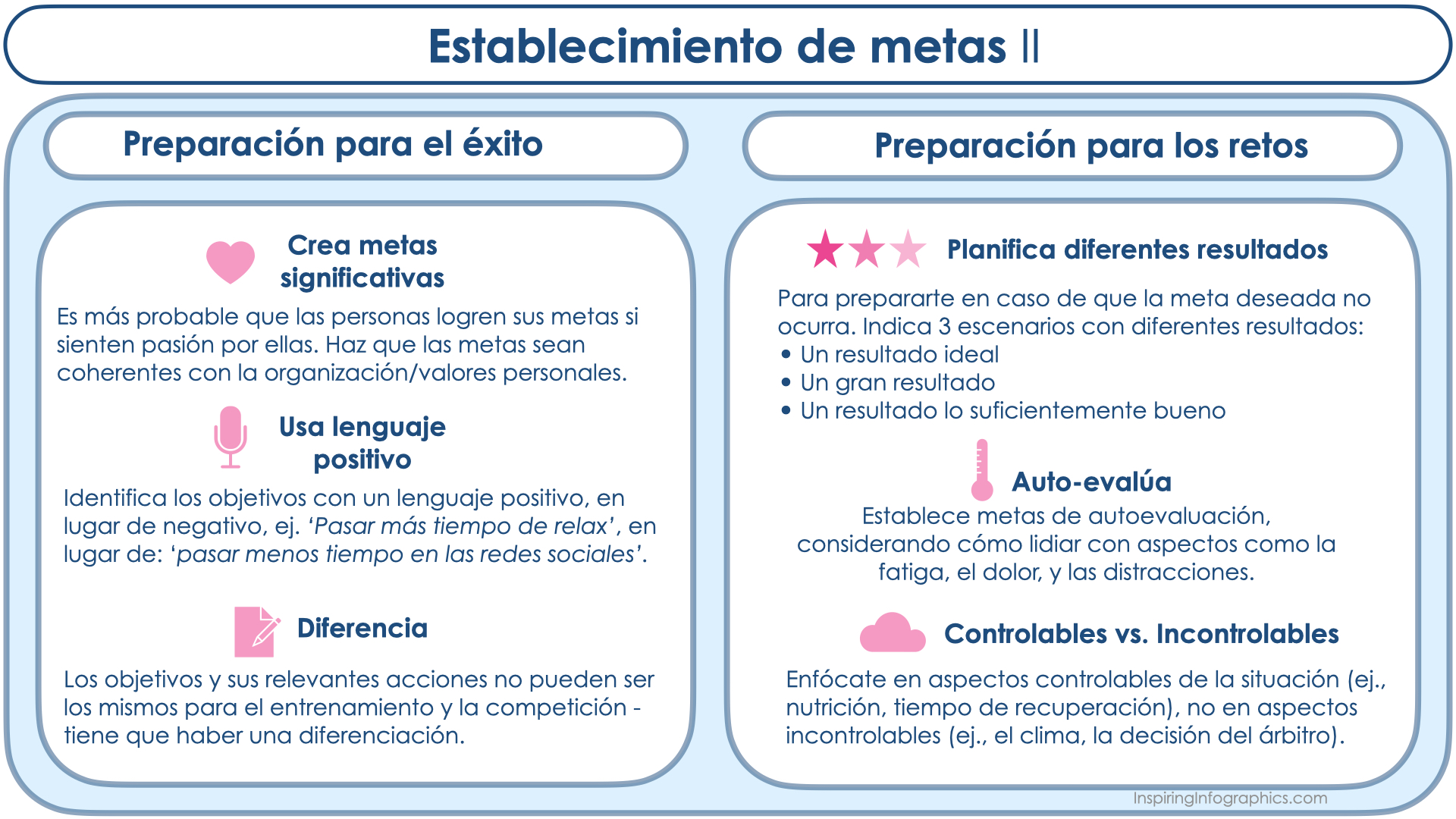
Antes de comenzar la preparación de entrenamiento es imprescindible establecer una meta para motivarnos, y estimular nuestro esfuerzo y aprendizaje. Para fijarnos una meta, (ej. completar una carrera de 10kms) tenemos que identificar lo que queremos conseguir (ej. terminar la carrera en un tiempo aproximado, o simplemente completarla), teniendo en cuenta el tiempo disponible, recursos, y condición física.
Cuando las metas sólamente se basan en lo que queremos conseguir entonces nos podemos desilusionar si no hemos identificado los pasos que nos pueden llevar a ella. Otra fuente de decepción es cuando nos fijamos metas que involucran aspectos que no podemos controlar como por ejemplo la velocidad de otros atletas. En este tipo de metas (ej., quedar primero en una competición) el esfuerzo se desaprovecha al compararnos con los demás.
Una vez nos hemos fijado una meta, hay que identificar al menos tres objetivos a corto plazo, siendo lo más específicos posible e incluyendo una fecha límite para conseguirlos (ej., hacer tablas de ejercicios complementarios de abdominales, cuádriceps y biceps tres veces a la semana, y hacer ejercicios de yoga en los días de descanso). También hay que identificar las acciones que necesitamos para conseguir los objetivos a corto plazo (ej., ir al gimnasio tres veces a la semana, consultar con el entrenador personal ejercicios de estiramiento y calentamiento en la primera semana).
La evaluación periódica de nuestros objetivos de rendimiento es un aspecto importante. Para ello puede resultar útil escribir en un diario los objetivos programados y el ejercicio que hemos realizado para comprobar si vamos cumpliendo los objetivos o si se deben modificar. En este diario también se puede reflexionar sobre los obstáculos que nos vamos encontrando y anotar ideas para poder superarlos.
Meta = el nivel de habilidad o rendimiento que queremos conseguir
Meta = Objetivos + Acciones
Fijarnos una meta nos ayuda a: motivarnos, esforzarnos, y aprender.
La meta debe ser realista, conteniendo objetivos y acciones ligadas a éstos.
Los objetivos y acciones tienen que ser específicos y tener una fecha limite.
Hay que evaluar periódicamente el progreso y si es necesario modificar los objetivos o acciones.


 InspiringInfographics