
Systematic reviews are a type of meta-research (research on research) in which primary research studies (e.g., randomised controlled trials) are included to answer a specific research question by synthesising the available evidence. They differ from narrative reviews as they are conducted in a standardised way, and the results and procedures could be replicated. Early systematic reviews were employed to study the efficacy of clinical treatments, and then they started to be used to address different questions about experiences, diagnostics, and prognostics. These days systematic reviews synthesise qualitative evidence too and some even include both quantitative and qualitative methods.
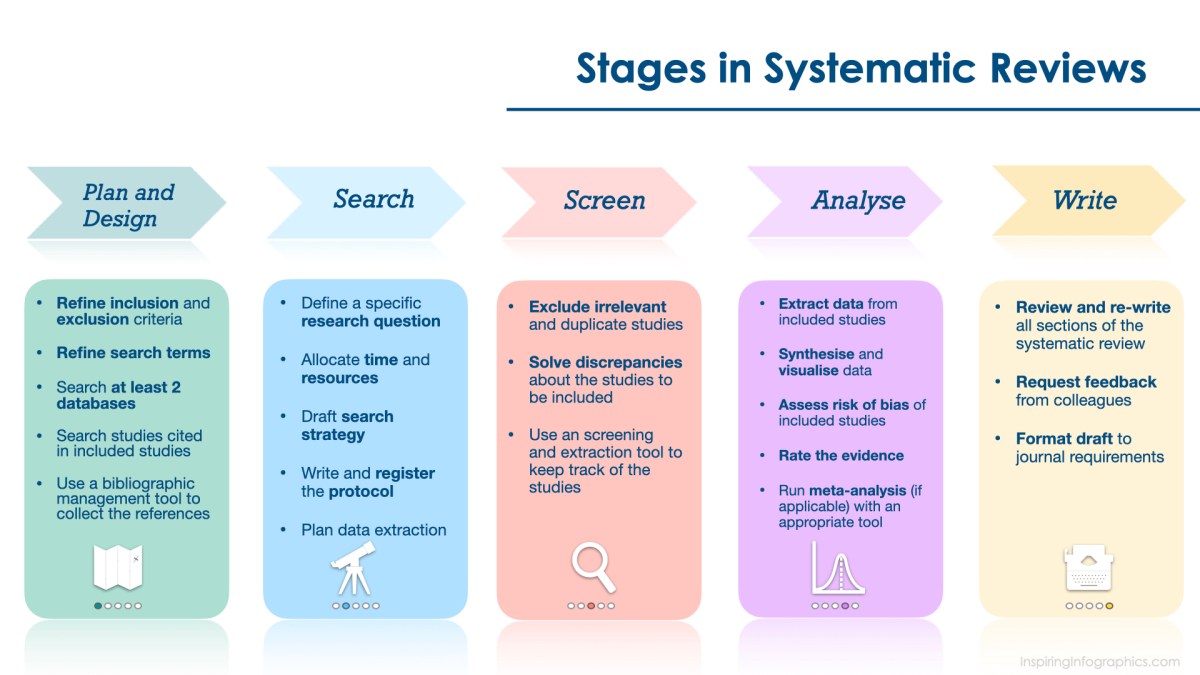
Several aspects are considered before beginning a systematic review, for instance, whether the research question has been answered already, and if so whether the systematic review needs updating, or could be conducted in a different way. If the research question is about addressing gaps in the literature or map out the evidence in different areas, then a scoping review is the best type. If an answer needs to be given quickly to an emerging topic, it may be worth conducting a rapid review. If the body of research already has systematic reviews, then, a systematic overview which will include several systematic reviews is conducted. Other aspects to consider at the planning stage are whether there is a need for a statistician to analyse the results, especially if a meta-analysis is conducted to obtain an overall effect size, and whether a methodologist is needed to check for bias within studies.
When searching and selecting the literature or creating the protocol, the PICOS or SPIDER summaries are used to help thinking about the suitability of the studies, and to identify the search terms. The PICOS summary is used for quantitative research, and it stands for: Participants, Intervention, Comparison, Outcome, (type of) Study (e.g., observational, cohort, cross-sectional, case study). The SPIDER summary is employed for qualitative research, and it stands for: Sample, Phenomenon of Interest, Design (e.g., interview) Evaluation (e.g., experiences), Research Type (e.g., qualitative, or mixed method).
To avoid bringing bias to the systematic review and make the process objective and transparent it is important to consider whether the search is limited to a specific year range, and whether is limited to English or more languages. Regarding the databases searched, they will have to be reported, and researchers usually search a minimum of two. Another way to bring more rigour to the process is to use a checklist of evidence-based items like the Preferred Reporting Items for Systematic Reviews and Meta-Analyses (PRISMA).
At the screening stage two reviewers decide which studies are included and which are excluded based on criteria agreed beforehand. Data extraction is the next stage, so the characteristics of the included studies are reviewed. Afterwards, the data is analysed and so the included studies are compared to see how homogeneous they are in terms of their designs, interventions, outcomes, and type of participants. On the last stage the quality of the overall evidence is assessed.
Systematic reviews add value to research. During the research planning they highlight whether more research is needed to confirm previous findings, and they point out any gaps in the research literature. In this way, systematic reviews help to avoid conducting unnecessary research, which in turn lead to a more efficient use of resources (e.g., by not wasting participants’ time, or exposing them to unnecessary treatments, and using research materials and funding in a more efficient manner). Systematic reviews add value to practice by helping to make informed decisions that are evidence-based, as they consider the evidence of a body of research set in a wider context, as opposed to considering results from just recent studies or few studies.
Las revisiones sistemáticas son un tipo de meta-investigación (investigación sobre investigación) en la que se incluyen estudios de investigación primaria (por ejemplo, ensayos controlados aleatorios) para responder una pregunta de investigación específica mediante la síntesis de la evidencia disponible. Se diferencian de las revisiones narrativas porque se llevan a cabo de manera estandarizada y los resultados y procedimientos podrían replicarse. Las primeras revisiones sistemáticas se utilizaron para estudiar la eficacia de tratamientos clínicos y luego se empezaron a utilizar para abordar diferentes cuestiones sobre experiencias, diagnósticos y pronósticos. Actualmente, las revisiones sistemáticas también sintetizan evidencia cualitativa y algunas incluso incluyen ambos métodos: cuantitativos y cualitativos.
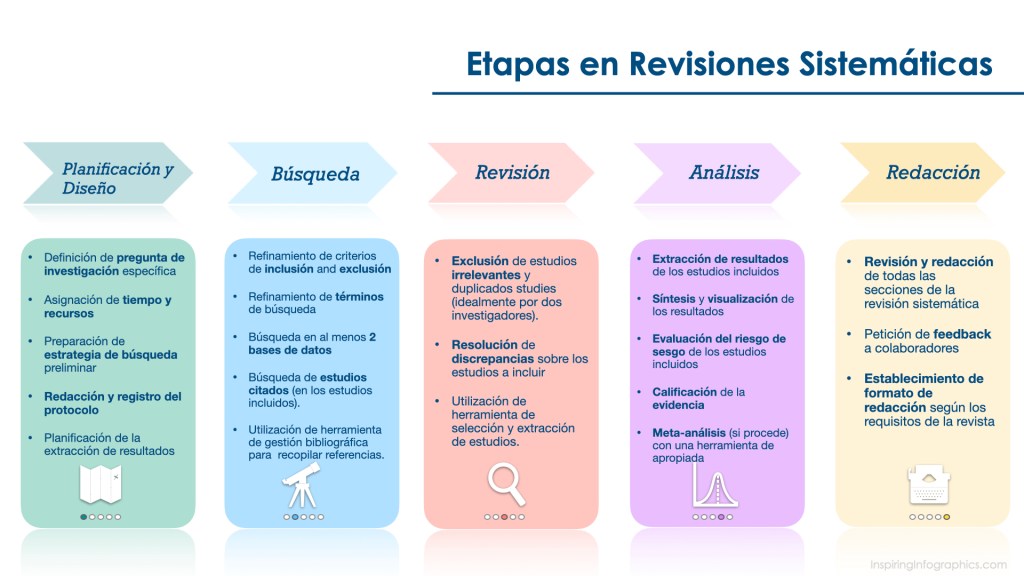
Antes de comenzar una revisión sistemática se consideran varios aspectos, por ejemplo, si la pregunta de investigación ya ha sido respondida y, de ser así, si la revisión sistemática necesita una actualización o podría realizarse de otra manera. Si la pregunta de investigación trata sobre abordar las lagunas en la literatura o trazar la evidencia en diferentes áreas, entonces una revisión del alcance es el mejor tipo. Si es necesario dar una respuesta rápida a un tema emergente, puede valer la pena realizar una revisión rápida. Si el cuerpo de investigación ya tiene revisiones sistemáticas, entonces, se lleva a cabo una descripción general sistemática que incluirá varias revisiones sistemáticas. Otros aspectos a considerar en la etapa de planificación son si es necesario que un/a estadístico/a analice los resultados, especialmente si se realiza un meta-análisis para obtener un tamaño del efecto general, y si se necesita un/a metodólogo/a para verificar el sesgo dentro de los estudios.
Al buscar y seleccionar la literatura o crear el protocolo, los resúmenes de PICOS o SPIDER se utilizan para ayudar a pensar sobre la idoneidad de los estudios y para identificar los términos de búsqueda. El resumen de PICOS se utiliza para la investigación cuantitativa y significa: Participantes, Intervención, Comparación, Resultado, (tipo de) eStudio (por ejemplo, observacional, de cohorte, studio transversal, estudio de caso). El resumen SPIDER se emplea para investigación cualitativa y significa: muestra (del inglés Sample), Fenómeno de interés, Diseño (por ejemplo, entrevista), Evaluación (por ejemplo, experiencias), tipo de investigación (del inglés: Research type (por ejemplo, método cualitativo o mixto).
Para evitar traer sesgos a la revisión sistemática y hacer que el proceso sea objetivo y transparente, es importante considerar si la búsqueda se limita a un rango de años específico y si se limita al inglés o a más idiomas. En cuanto a las bases de datos buscadas, habrá que declararlas; los investigadores suelen utilizar un mínimo de dos bases de datos. Otra forma de aportar más rigor al proceso es utilizar una lista de verificación de elementos basados en la evidencia, como los elementos de informes preferidos para revisiones sistemáticas y meta-análisis (PRISMA), (del inglés: Preferred Reporting Items for Systematic Reviews and Meta-Analyses).
En la etapa de selección, dos investigadores deciden qué estudios se incluyen y cuáles se excluyen según los criterios acordados de antemano. La extracción de datos es la siguiente etapa, en la que se revisan las características de los estudios incluidos. Posteriormente, se analizan los datos y se comparan los estudios incluidos para ver lo homogéneos que son en términos de sus diseños, intervenciones, resultados y tipo de participantes. En la última etapa se evalúa la calidad de la evidencia general.
Las revisiones sistemáticas agregan valor en la investigación. Durante la planificación de la investigación, destacan si se necesitan más estudios para confirmar hallazgos anteriores y señalan cualquier laguna en la literatura. De esta manera, las revisiones sistemáticas ayudan a evitar la realización de investigaciones innecesarias, que a su vez conducen a un uso más eficiente de los recursos (por ejemplo, al no hacer perder el tiempo a participantes, o exponerlos a tratamientos innecesarios, y utilizar materiales de investigación y financiamiento de una manera más eficiente). Las revisiones sistemáticas agregan valor en casos prácticos al ayudar a tomar decisiones informadas que se basan en evidencia, ya que consideran la evidencia de un cuerpo de investigación en contexto, en lugar de considerar solamente resultados de estudios recientes o simplemente resultados de algunos estudios.
 InspiringInfographics